Part 2: Impact of Blaze Promotion
In the first part of the cascade metric series, we learned that despite Martin & Bosco’s post having over 350,000 total notes, the majority of reblog chains are short. But the post keeps traveling because so many people reblog a version of it at least once. In this second part, we focus specifically on the shape of the reblog network while Martin & Bosco’s post is actively being blazed.
What is Blaze?
Blaze is Tumblr’s version of a paid or sponsored post, but it works differently from ads on other social media platforms. Tumblr users mostly pay to force random strangers to look at their pets or new fan fiction, but they can also sponsor other users’ posts. Indeed, they have blazed Martin & Bosco’s post 19 times (as of January 2026). A blaze period is the 24-hour window during which a post is promoted. However, only the original version of a post can be promoted; reblogs cannot be blazed (“Blaze FAQ,” n.d.). This is why the analysis focuses on reblogs of Martin & Bosco’s original post during blaze periods.
The Cascade Metric Series
The four-part blog series uses Martin & Bosco’s post to show how reblog cascades form, grow, and distribute attention across Tumblr. Each part focuses on a different force shaping that spread:
- Part 1: the overall structure of the network
- Part 2: the impact of blaze as a platform intervention ❖
- Part 3: how an individual user (Laura, the author) influences the spread
- Part 4: what we learned and the methodology.
Refer to Figure 1 (below) if you want a quick refresher on terms like reblog chain, reblog hop, parent, child, fork, and branch while reading the statistics. Tumblr users will likely recognize these patterns from daily use of the platform.
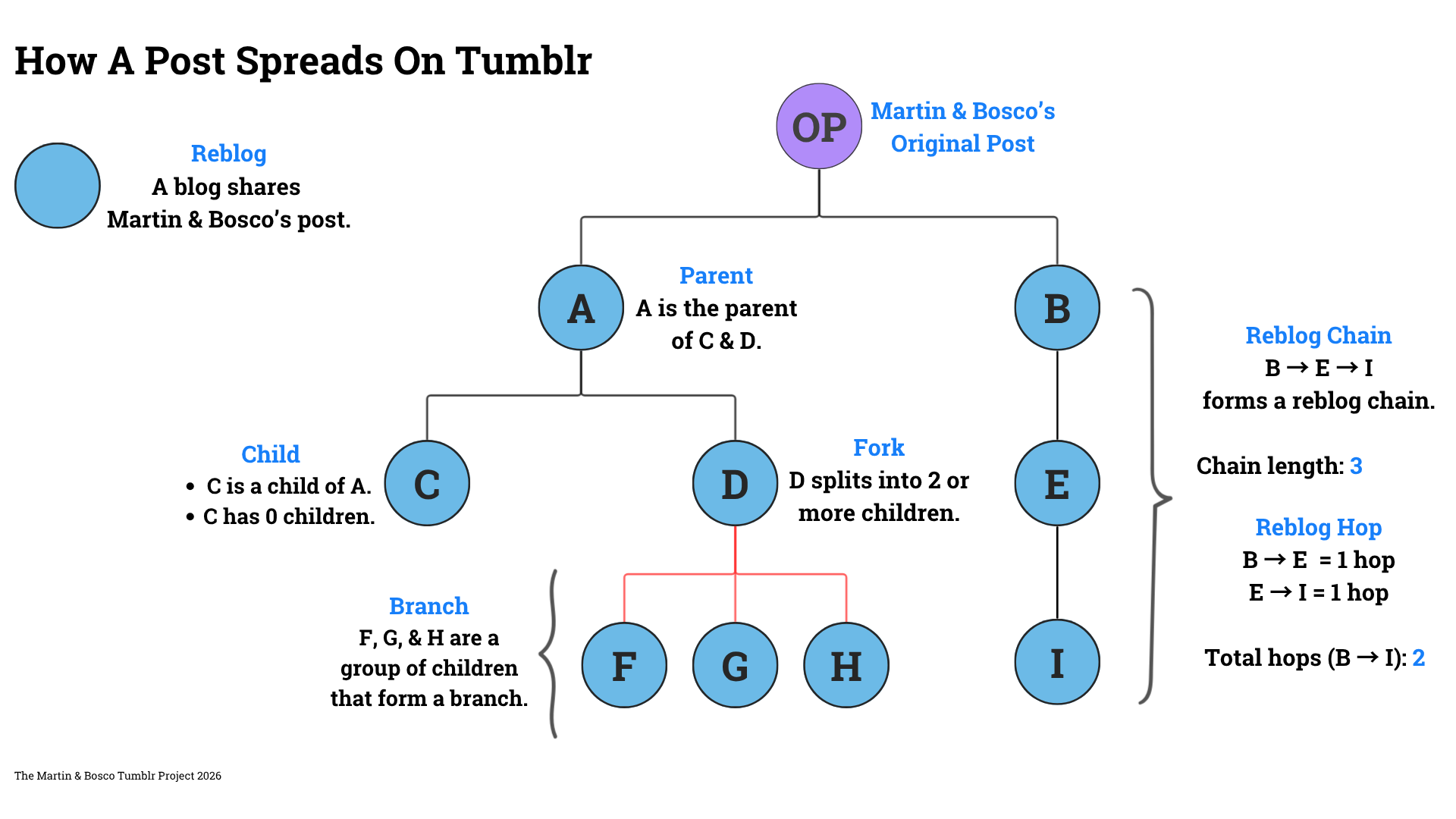
Figure 1: Network diagram showing how a Tumblr post spreads through reblogs. It introduces key terms used on this page.
- Total blaze periods: 19
- Date range: Aug 2023 to Jan 2026
- Total reblogs: 28,556 (21.1% of all reblogs in the cascade)
-
Reblogs of the OP: 5,894
- Only 20.6% of all reblogs during blaze periods
- But 69.3% or most of all reblogs of the OP in the overall cascade
- Reblogs of the OP without any children: 4,867 (82.6%)
- Reblogs of the OP with one child: 734 (12.5%)
- Reblogs of the OP with two or more children: 293 (4.97%)
-
Reblogs of other versions of the post: 22,662 (79.4% of all reblogs during blaze periods)
The majority of reblogs of the original post (OP) occurred during blaze periods. The total number of direct reblogs of the OP is surprisingly small given that it has been blazed 19 times. Most of these direct reblogs of the OP were not shared again. Instead, during blaze periods, the majority of reblog activity came from people reblogging other versions of Martin and Bosco’s post that were already circulating.
To summarize, blaze shines a spotlight on the original post, but the reblog network mostly keeps doing its own thing.
Data Statement
- Data updated: Feb. 02, 2026
- Total posts (including the original post): 135,296
-
Data were collected using Tumblr’s public
/postsAPI endpoint, and no access-circumvention methods were used. Aggregated metrics were calculated from reblogs successfully returned by the API. Updated annually.
A Closer Look
Let’s look at three figures to help understand the 22,662 reblogs metric. This value counts reblogs during blaze periods that are not direct reblogs of the original post (OP). In other words, these are reblogs of other versions of Martin and Bosco’s post.
-
The colourful stacked bar chart (Figure 2) shows where these reblogs appear within the cascade during blaze periods. While most reblogs (62.2%) attach under existing forks, the chart also shows other paths activity can take. Some reblogs extend continuous chains, some reblogs appear under reblogs of the OP, and others occur where the parent post is missing or not visible to Tumblr’s API. Seeing these categories together makes it easier to visualize how blaze activity fits into the broader reblog network.
-
The grey section of the bar chart in Figure 2 represents the 3,094 (13.7%) reblogs where the parent post is missing or not visible to Tumblr’s API. Figure 3 shows what this looks like in practice. In some cases, a reblog appears in the dataset but the post it reblogged from is missing. This can happen if the parent post was deleted, the blog is private or deactivated, or the post is otherwise unavailable to the API. The result is a broken chain: the reblog is visible, but the step connecting it to the rest of the cascade is missing. Tumblr’s API only provides a window into the reblog network, not the entire cascade.
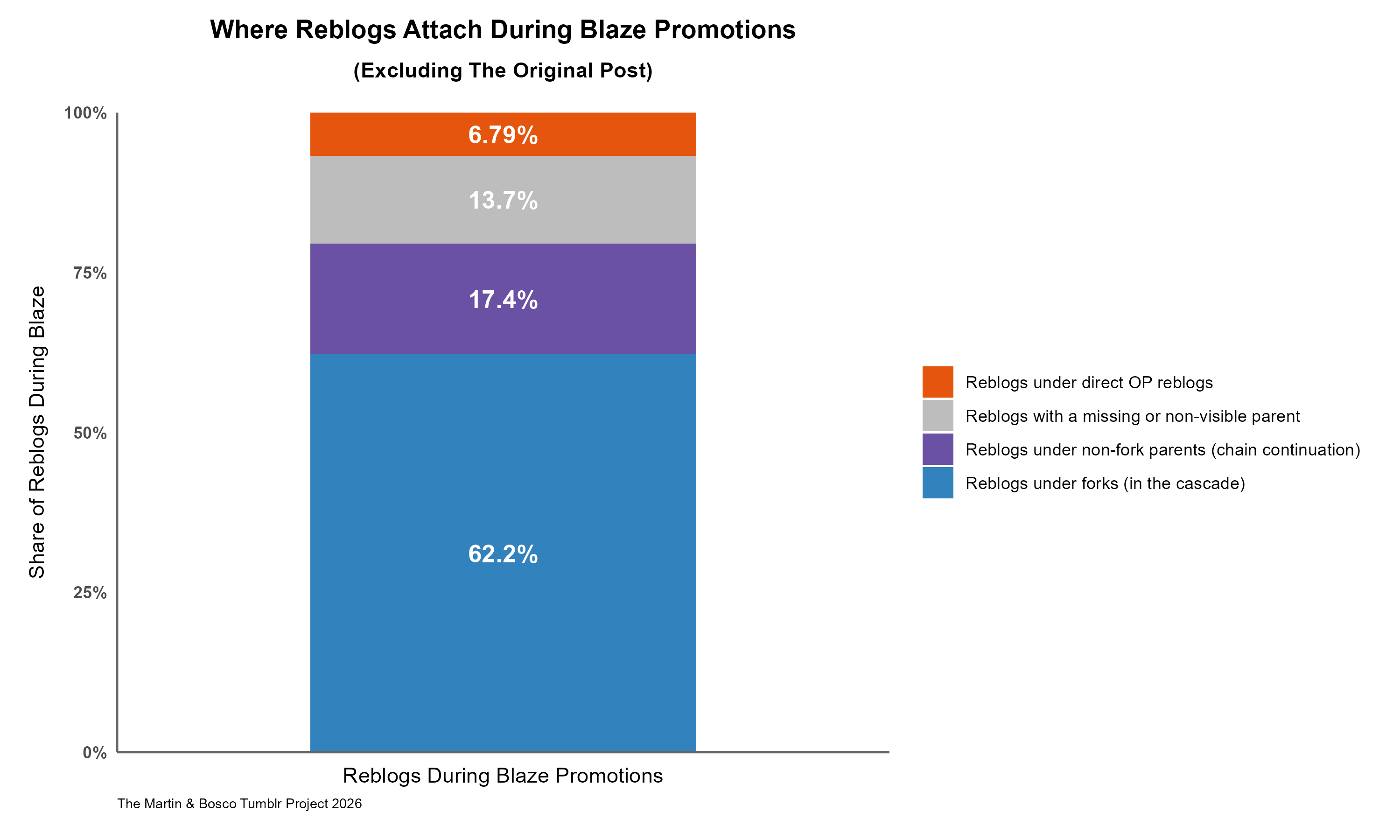
Figure 2: The plot shows where reblogs of other versions of Martin & Bosco’s post appear in the cascade during blaze periods. The majority occur under existing forks in the reblog network.
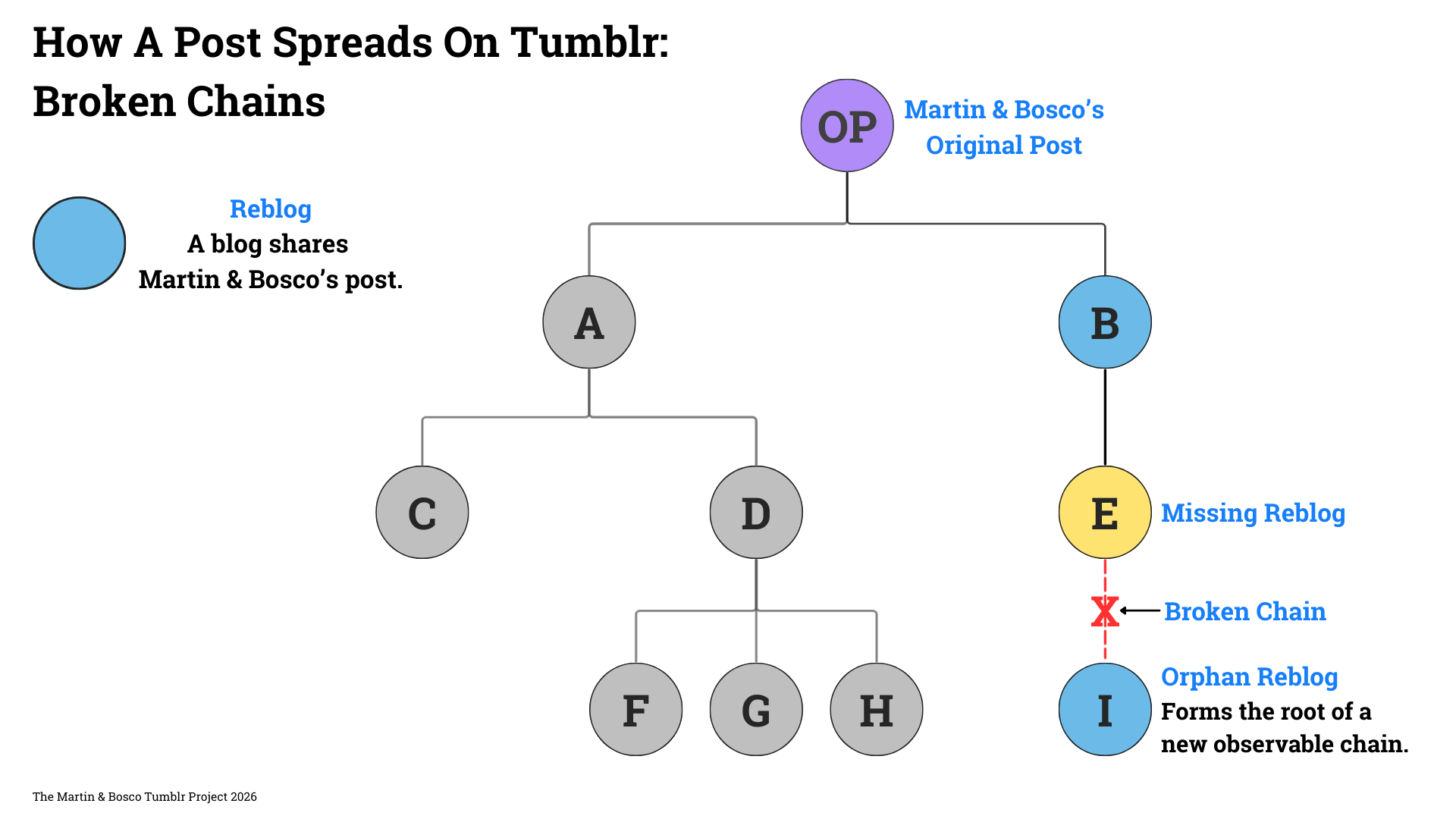
Figure 3: The diagram shows how a missing parent post breaks the observable reblog chain.
-
The purple section of the bar chart in Figure 2 represents the 3,935 (17.4%) reblogs that extend existing chains during blaze periods. In a chain, each reblog follows directly from the previous one rather than splitting into multiple branches.
-
The blue histogram (Figure 4) shows the distribution of these continuous chain lengths. During blaze periods, chains tend to run a bit longer than in the overall cascade. The median chain length is 5 reblog hops, compared with a global median of 3. (You can see the histogram for the global cascade here.) The overall shape of the distributions is similar. Most chains are short, with a long right tail of the rarer, deeper ones. The longest chain here reaches 30 reblog hops, compared with 38 in the full cascade. The far-right bars are tiny because only a handful of chains reach those depths.
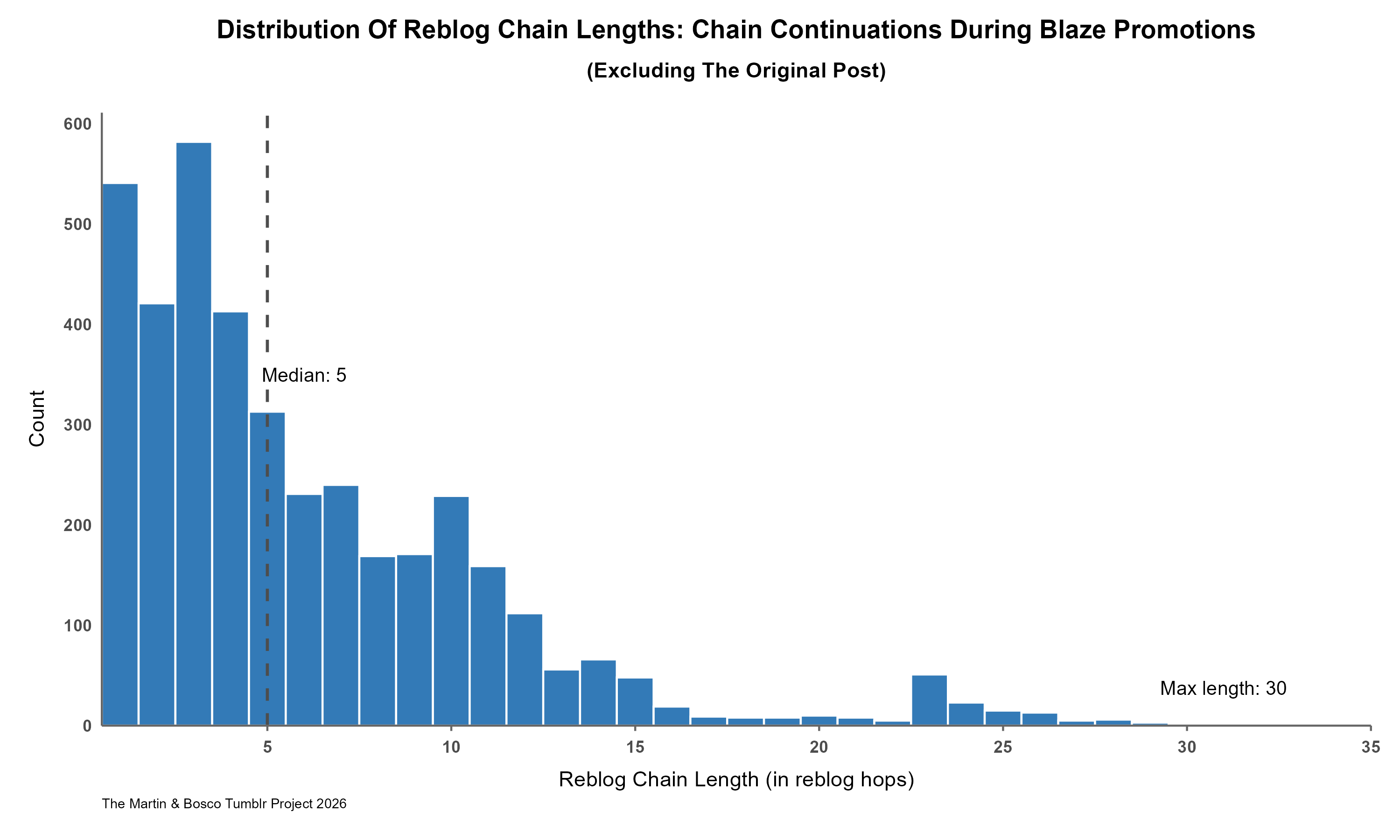
Figure 4: The plot shows the distribution of reblog chain lengths, measured in reblog hops. Most are short, but there is a long tail of rarer deep chains. The dashed line marks the median.
Test Your Knowledge
Question: Blaze promotions highlight the original post. Why do you think most reblog activity happens under other versions of Martin & Bosco’s post?
Answer
Cascade metrics describe the structure and timing of how a post spreads, but they cannot tell us why users make the choices they do. Research on information cascades and, somewhat unexpectedly, music recommendation systems suggest a few possible explanations.
Studies of social sharing show that repeated exposure can increase the likelihood that users will share a post after encountering it multiple times (Zhou et al., 2015). However, Cheng et al. (2016) found that when multiple copies of a post circulate, sharing does not necessarily return to the original source. Instead, users select and redistribute different versions of the same content — sometimes adding or modifying the overlaid text before sharing it. A classic example of this behaviour on Tumblr is the “Guy Ranting to Drive-Thru Employee” drawing, where users add their own text to the speech bubble before sharing (Gert [@oops! all ocs], 2020). Taken together, these findings suggest that exposure may increase sharing overall, but not which version of a post is propagated.
But what happens when a platform intervenes by actively placing content in front of users? Let’s look at how Spotify’s Discovery Mode works. Artists select songs to feature, and Spotify’s algorithm increases how often those songs are recommended in places like Radio, Autoplay, and Mixes (“Discovery Mode Contexts,” 2026). A paid song “injection” serves a specific, limited purpose: it lowers the initial search cost by placing a song directly in front of listeners. However, the promoted track often acts as a gateway to an artist’s catalogue rather than the final destination (“Discovery Mode,” 2026). The Cog report shows this in practice. When the band’s older “catalogue” tracks were injected via Discovery Mode, over 57% of streams came from listeners who manually navigated to the album itself (the “Artist Source”) rather than staying in the paid feed (“Cog in Discovery Mode,” 2024).
On Tumblr, the blazed OP follows a similar pattern, but promotion of Martin and Bosco’s post is user-driven rather than creator-driven. The OP is injected into dashboards, but reblogs during blaze periods are frequently attached to other versions of the post in the reblog network. This behaviour isn’t surprising given Tumblr’s strong culture of actively asserting control over the user experience. Users transform posts by adding tags or commentary, and they shape the reblog network by curating which version of a post to share. They also influence how content is delivered by famously rejecting changes to the platform’s interface (Minkel, 2023).
On both the Spotify and Tumblr platforms, the promoted item acts as an entry point, while engagement continues elsewhere in the catalogue or network. Understanding how injected content moves through an existing network matters for both artists and users. Artists like Cog are already strategically leveraging this dynamic in their marketing plans. However, users who understand it are more difficult to manipulate because they can recognize when a platform feature is shaping their attention and choose whether to push back on it.
► Future work will examine where reblogs attach within the cascade during blaze periods. This will determine whether features such as the presence of tags or commentary help explain why reblogs attach to other versions of the post rather than the promoted OP.
Stay Tuned
We saw that during blaze periods, the reblog network continues to spread Martin & Bosco’s post in its own way. In the third part of the series, we’ll explore how Laura’s reblogs shape the way the post travels.
Next Up: Part 3: Laura’s Role in the Reblog Network ➝